AI Adoption Made Simple: The Power of Outcome-Based Freemium
How outcome-based freemium replaces seat and usage pricing — and why it's the smoothest path to AI adoption as customers shift from operator to overseer.
Today, many AI-enabled products still rely on seat-based and usage-driven pricing models. Customers pay based on the number of users or specific tasks performed, such as processing customer support tickets, running data analysis jobs, or generating reports. However, the market is increasingly transitioning toward usage-based and outcome-based pricing models, especially in AI-driven automation and analytics solutions. This model offers predictability and aligns with frequent user interactions, driving steady revenue streams. However, it also reinforces high-frequency usage patterns, meaning customers are frequently required to interact with the system to initiate or complete tasks. For example, in customer support tools, users must often categorize and assign tickets manually before AI takes over, keeping them heavily involved in routine operations.
Why this model persists
- Predictable revenue: Recurring income based on user licenses.
- High user engagement: Users frequently interact with the system to initiate or monitor tasks, which helps maintain consistent activity metrics and user engagement data, though it may not always reflect direct value delivered.
- Budget simplicity: Customers appreciate knowing their monthly costs upfront, tied to straightforward metrics such as user count or the volume of tasks processed, which simplifies budgeting and cost management.
Example: Many traditional SaaS products, particularly older customer support and CRM tools, have historically relied on per-seat pricing models. However, modern AI components within these systems are increasingly adopting usage-based and outcome-based pricing, especially for automation and advanced analytics features.
What is a job map?
A job map defines the precise steps a core job executor must take to accomplish a specific job-to-be-done (JTBD). According to the Jobs-to-be-Done framework, there are eight steps in a job map:
- Define: Identify the desired outcome.
- Locate: Find relevant inputs or resources.
- Prepare: Organize and ready the inputs for execution.
- Confirm: Ensure everything is in place to begin the job.
- Execute: Perform the core action of the job.
- Monitor: Track progress and check for accuracy.
- Modify: Adjust as necessary to achieve the desired outcome.
- Conclude: Finalize and assess the outcome.
Example of a customer support job map
- Define: Identify the type of inquiry and its urgency.
- Locate: Gather relevant customer information and previous interaction history.
- Prepare: Ensure necessary resources are available to resolve the inquiry.
- Confirm: Validate the inquiry’s details before processing.
- Execute: Resolve the inquiry using AI tools or manual support.
- Monitor: Track the resolution progress and check for accuracy.
- Modify: Adjust the response if new information arises.
- Conclude: Close the inquiry and document the resolution for future reference.
In AI-enabled products, the objective is to cover as many steps of the job map as possible — automating multiple stages and delivering complete outcomes with minimal human intervention. As AI takes on more of these steps, the customer’s focus naturally shifts to the monitoring phase, where they track progress, ensure accuracy, and optimize outcomes rather than manually executing tasks. This shift reduces the frequency of direct interactions with the system, as the customer evolves from an operator to a supervisor. In this supervisory role, outcomes become far more important than usage or participation, fundamentally changing how value is measured.
Outcome-based freemium: the future of acquisition
For AI-enabled products, customer willingness to pay is directly linked to how comprehensively the product covers the customer’s job map. The more extensively the product addresses the job map, the greater its perceived value, making customers more inclined to invest. Unlike traditional tools, which may address only a part of a JTBD, AI-enabled products can cover much more — often managing the entire workflow — providing comprehensive solutions across the job map. As the product expands its scope and demonstrates its ability to deliver outcomes across multiple workflows, the perceived value increases dramatically.
How outcome-based freemium works
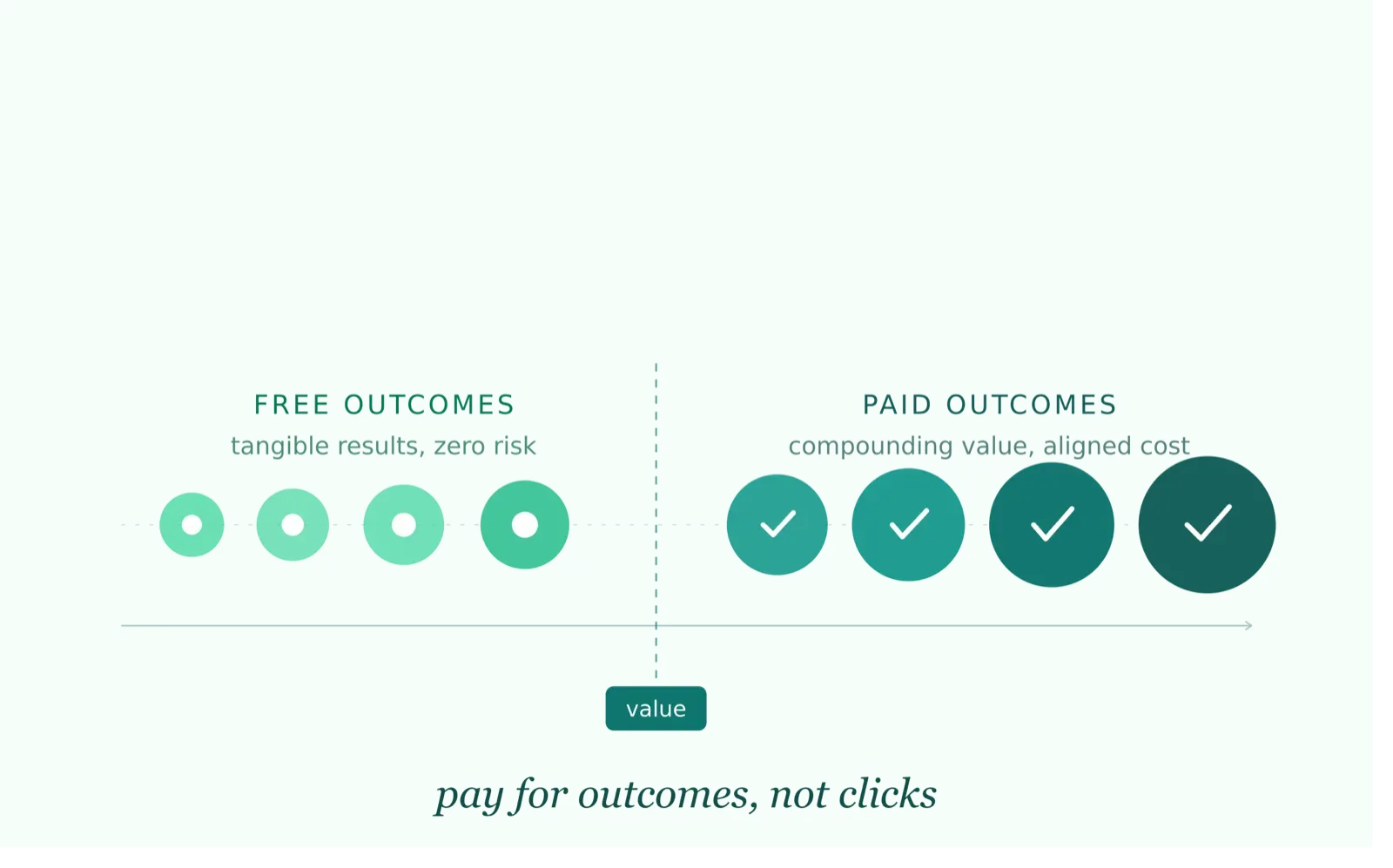
In this model, customers receive a set number of complete outcomes for free. Once they experience the value, they transition to a paid plan that combines a base fee with per-outcome charges.
Example:
- Freemium offer: Solve 30 customer support tickets for free.
- Paid plan: After 30 outcomes, the customer pays a $100/month base fee plus $1 for each additional ticket.
Why this model works
- Immediate value: Customers experience tangible outcomes, not just features.
- Low commitment: Free outcomes reduce the friction of trial adoption.
- Smooth conversion: Users who see results are more likely to convert to paid plans.
Hybrid pricing for sustainable growth
Outcome-based freemium serves as an entry point, but sustainable growth requires a hybrid pricing model. This combines predictable base fees with scalable per-outcome charges.
Example hybrid model:
- Base fee: $200/month for up to 200 outcomes.
- Per-outcome charge: $2 per additional outcome beyond the base plan.
This approach balances revenue predictability with flexibility, aligning costs with value delivered.
The new role of the customer: administrator and overseer
As AI products take over the majority of tasks, the customer’s role shifts from task execution to oversight and optimization. During the trial period, customers monitor how the AI handles tasks and evaluate performance across their entire job map.
Key responsibilities of the customer
- Monitoring outcomes: Track key performance metrics such as task completion rates and accuracy.
- Configuring the AI stack: Adjust settings to optimize performance and tailor the AI to specific business needs.
- Intervening strategically: Step in only when exceptions or strategic decisions require human input.
Transforming the acquisition journey
To drive mainstream adoption, AI-enabled products need a fundamentally new acquisition journey. This journey must focus on:
- Longer, outcome-centric trials: Trials should cover enough time and scope for customers to see how the AI handles varied conditions.
- Predictable pricing structures: Hybrid models ensure customers can scale without unpredictable costs.
- Personalized, AI-driven onboarding: AI systems can guide users toward quick wins and adapt onboarding based on user behavior.
Conclusion: building the future of AI monetization and acquisition
The future of AI-enabled products lies in outcome-driven, job-centric acquisition models. Traditional SaaS strategies must give way to new approaches that allow customers to experience real outcomes and adopt the role of administrator and overseer.
To achieve this, it is crucial to reduce adoption friction. Customers need to feel confident and comfortable transitioning to a new product without extensive learning curves or operational disruptions. Outcome-based freemium delivers exactly that by offering tangible results upfront, allowing users to experience the value of AI-enabled products without initial risk. This builds trust and creates a smoother path toward full adoption.
By combining outcome-based freemium, hybrid pricing, and full-spectrum trials, companies can reduce adoption friction, build trust, and drive sustainable growth. This new paradigm not only aligns with how customers want to adopt technology but also sets the stage for long-term success in the AI-driven future.