From Operator to Overseer: Why AI-Native Software Changes Everything About Human Work
AI is transforming the human role from operator to overseer. Here's what that means for software design, enterprise operations, and competitive advantage.
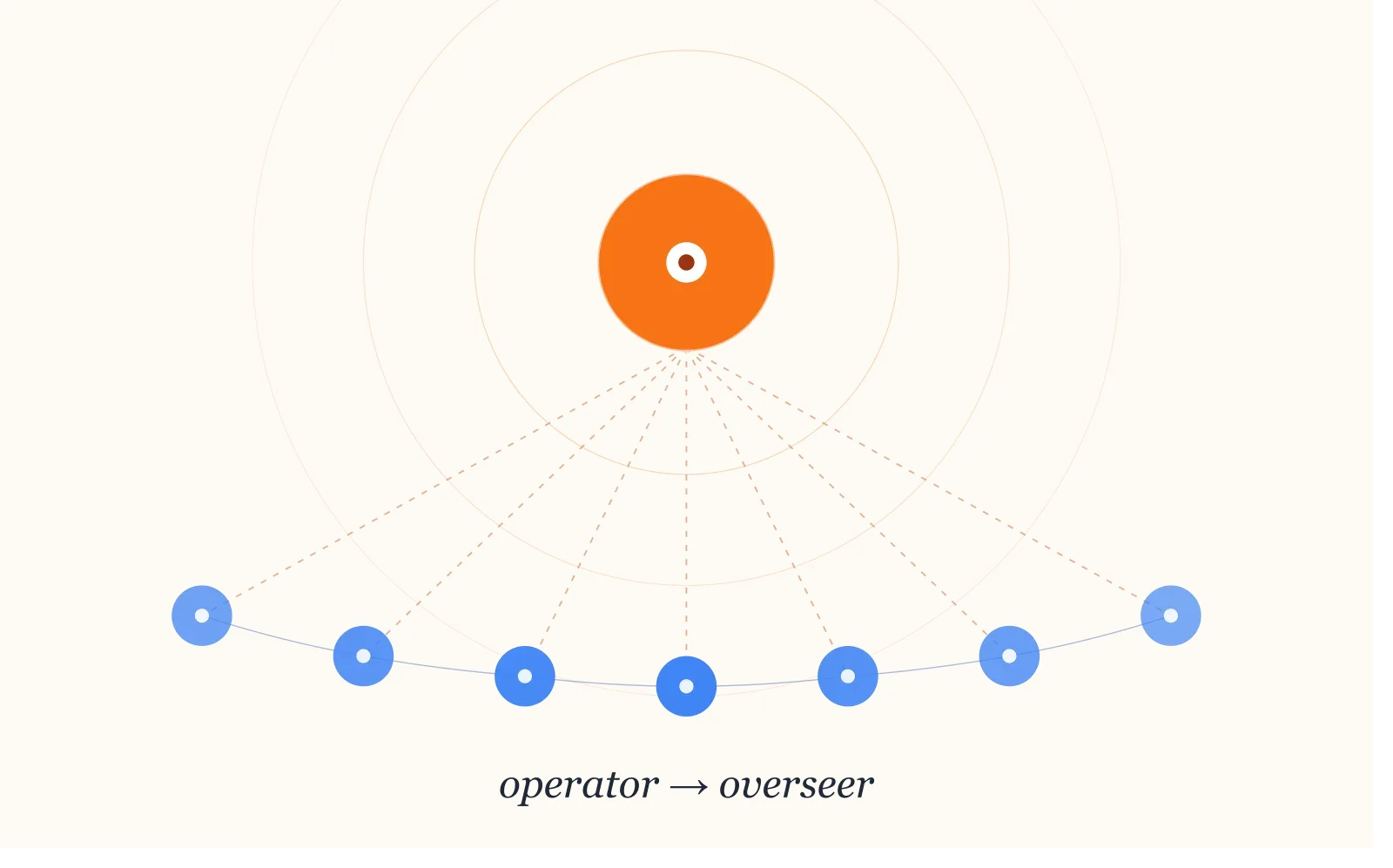
Traditional software treats humans as operators: users who click, type, configure, and execute tasks within digital systems. But AI-native software introduces a fundamentally different paradigm — humans as overseers who set strategy, monitor outcomes, and intervene only when needed. This shift isn’t just about automation; it’s about redefining the relationship between humans and technology to unlock unprecedented efficiency and strategic focus.
Most businesses are still building software as if humans will remain operators forever, missing a massive opportunity to align with how work actually gets done when AI handles execution. The companies that recognize this transition early will gain decisive competitive advantages.
The four pillars of role transformation
When AI takes over execution, four fundamental changes reshape how humans interact with software.
1. From controlling to configuring
Traditional: Users manually perform each step, making decisions in real-time. AI-native: Users set strategic parameters and let AI execute within those boundaries.
Example: Instead of manually categorizing customer support tickets, a manager configures response tone, escalation criteria (sentiment score below 0.3), and approval workflows (auto-send for routine issues, human review for refunds over $500).
2. From monitoring activities to optimizing outcomes
Traditional: Dashboards show what happened — emails sent, tickets processed, calls made. AI-native: Interfaces display what was achieved — customer satisfaction improved 12%, lead conversion increased to 23%, resolution time reduced 40%.
3. From executing to instructing
Traditional: Humans perform the work while software provides tools. AI-native: Humans provide context and constraints while AI performs the work.
Example: A marketing manager briefs the AI: “Focus on thought leadership this week, promote the webinar, maintain our expert-but-approachable tone, avoid controversial topics.” The AI creates and schedules content; the human provides strategic direction.
4. From reactive to predictive
Traditional: Humans respond to issues after they occur. AI-native: AI identifies potential issues before they happen, suggesting proactive interventions.
Example: “Customer churn risk increased 15% due to delayed response times. Suggest adding two support agents Thursday–Friday” — rather than scrambling after complaints spike.
Real enterprise transformation
The shift from operator to overseer is happening across industries.
Healthcare: At Cleveland Clinic, radiologists moved from spending 60% of their time on documentation to focusing on complex diagnostic decisions. AI handles routine imaging analysis and report generation. Radiologists now configure diagnostic parameters and review exception cases. Result: 40% faster diagnosis, 25% better early detection, 60% less administrative overhead.
Financial services: JPMorgan’s investment advisors shifted from manual research to strategic client consultation. AI analyzes market data and creates proposals while advisors configure risk parameters and focus on relationships. Result: 70% more client face time, 35% increase in assets under management, 50% faster proposals.
Manufacturing: Tesla’s production managers moved from manual supply chain coordination to strategic optimization oversight. AI handles supplier coordination and scheduling while managers set production priorities. Result: 30% less downtime, 25% better quality metrics, 45% faster supply chain response.
These transformations share a common pattern: AI assumes operational execution while humans elevate to strategic oversight roles.
The software architecture of oversight
Building software for overseers requires different design principles.
Outcome-centric interfaces: Show impact metrics (objectives achieved, problems prevented), not activity metrics (tasks completed, emails sent). Every screen should answer “What business outcome was achieved?” not “What activity occurred?”
Strategic control panels: Provide parameter controls (risk tolerance, quality thresholds, escalation criteria), not step-by-step workflow management. Users configure objectives and constraints, not individual tasks.
Exception-based alerts: Surface only situations requiring human judgment (edge cases, strategic decisions, performance anomalies), not constant status updates. AI handles routine; humans focus on exceptional.
Predictive recommendations: Suggest strategic interventions based on patterns (“Customer churn risk increasing,” “Market opportunity detected,” “Resource optimization available”), not just operational data. Provide strategic intelligence that enables proactive decision-making.
The competitive advantage of supervisor-first design
Companies building AI-native software with oversight paradigms gain significant advantages.
Faster decisions: Executives focus on “what should we do?” not “how do we do it?”
Higher-value work: Employees shift from task execution to strategic thinking and relationship building.
Scalable operations: One manager can oversee AI operations that previously required entire teams.
Competitive differentiation: While competitors struggle with operator-centric software, oversight-first companies move faster and focus human talent on genuine strategic advantage.
Implementation strategies
Start with high-volume, rule-based processes: Customer support, lead qualification, content creation, and data analysis are ideal starting points where clear parameters exist.
Design for configuration, not control: Build interfaces for strategic parameters, not task management. Think “set cruise control and destination,” not “steer every turn.” Focus on outcomes, not activities.
Measure outcomes, not activities: Focus on business impact achieved rather than tasks completed. Track customer satisfaction improvements, pipeline quality, and strategic objectives.
Train for oversight skills: Develop strategic thinking, pattern recognition, and systems optimization capabilities. The future workforce needs oversight competencies, not operational efficiency.
The future of human–AI collaboration
As AI capabilities expand, the operator-to-overseer transformation will accelerate. Companies embracing this shift early gain substantial advantages in efficiency, employee satisfaction, and competitive positioning.
The question isn’t whether this transformation will happen, but whether your organization will lead it or scramble to catch up.
The new competitive advantage isn’t having the best operators. It’s having the best overseers.
Organizations that redesign their software, processes, and human roles around strategic oversight will dominate their industries. Those clinging to operator-centric thinking will find themselves managing inefficient busywork while competitors focus human talent on genuine strategic advantage.
The great handoff from operator to overseer has begun. The winners will be those who embrace it fastest.